Costa Rican Cuisine

We’ve only eaten out a few times, and one of those times was for (disappointing) Chinese while two other times were (mediocre to okay) pizza. But we have had actual Costa Rican food three other times and while it has its good points, I think there’s a reason it’s not as popular worldwide as other Latin fare, like Cuban, Mexican, or even Salvadorean.

The big turn-off for us is the mayo. Actually not just mayo but ketchup also seems to be a major ingredient. An enchilada, with meat, black beans, tomatoe, and yes, mayo and ketchup drizzled on top. French fries (everything seems to come with fries, which, to be honest, feels like an awkward fit — what happened to beans and rice on the side?) also come with both mayo and ketchup drizzled on top. A burrito with, instead of salsa inside, some kind of mayo-based special sauce.

It’s been a little frustrating, as we’ve constantly found ourselves disappointed by menus which feature burgers, fried chicken (oh, there’s so much fried chicken), and then a small selection of Latin fare. Then, even after we order Latin dishes, it comes with a burger-type “special sauce”.

The result is a sickly sweetness and creaminess to things that are supposed to be savoury and spicy. Of course I recognize there is a degree of cultural bias here. I can’t dictate what food is supposed to taste like. It’s all about what you’re used to. Obviously Costa Ricans like their food this way, and other countries, like Chile, have similar cultural traditions.

But it does make me suspect there has been a major US cultural invasion on the food. I wish we could go back in time to Costa Rica 25 years ago to figure out how much of what we’ve been eating is traditional and how much of it is part of a more recent trend to fast food.

Whatever the answer, we know what we like, so we’ll have to request no mayo next time we order.

The Omnivore’s Dilemma – Much Ado About Corn

I’m reading The Omnivore’s Dilemma after literally having it on my reading list for three years (and in my physical book-pile for one). Another excellent example of scientifically-literate long-form journalism. I do recommend it, even if it also takes you three years to get around to reading it. (Those who want to delve deeper into topics like these sometimes look into classes from accredited online colleges.)

The first few chapters are all about corn, and how it’s behind everything we eat. Some Nixon-era agricultural reforms, WWI-era innovations in industrial chemistry (i.e., the Haber-Bosch process for making synthetic nitrates), and some clever Depression-era cross-breeding combined to create the perfect storm for the agricultural industry.

Long story short, the United States produces way more corn than it needs, therefore it gets used for everything, and the flooded market drives the price of corn down to maybe 60% of what it costs to produce. The government subsidizes the farmers to keep them afloat, but it’s still not a very profitable business for farmers.

Rather, it’s the secondary industries that get filthy rich from the massive availability of artificially cheap corn. The beef industry feeds their cows on corn rather than grass (which is free) because they can keep their pre-slaughtered meat in stalls rather than investing in grazing land. Recent studies suggest that the heart issues associated with red meat may be more due to the corn-fed diet of our red meat, rather than the red meat itself.

Meanwhile Coca-Cola and similar companies turn something that’s nutritious enough in its natural form to be a staple crop for some cultures, into diabetes in a can for North Americans who don’t need the extra calories (perhaps you thought it was sugar in your carbonated beverages, but in North America it’s not, it’s high-fructose corn syrup).

If you go further back, it’s not even corn at the base of our food chain, it’s oil. The Bosch-Haber process we depend on for our artificial fertilizers is energy intensive and requires more energy from fossil fuels put into it than the food energy we get out of it. But without artificial fertilizers, the ridiculous yields that cause corn to be practically worthless would not be possible. So we’re burning all the oil we can to create more corn than we need, which we then dispose of in any way possible, usually at the detriment of our own health.

It’s a great deal for certain industries and terrible for almost everyone else. But it’s an interesting example of how very different issues can be related: human health, environmental issues, industry, economics, government policy, consumer behaviour.

Some Things You Probably Didn’t Know About Me

While I was trying to track down a project from a former teacher (and colleague) of mine, I came across this interview I did a couple years ago. Or rather, a reprint of said interview.

1) What is your non-academic drudgery?
I’m a expensive inculcate information and math docent.
2) What is your information CV?
I monkeyshines a chaff on a B.Sc, majoring in physics, with a babies fellow in mathematics, followed away a B.Ed location, chief years advance (i.e., expensive school). Both of these degrees are from the University of Winnipeg, in Canada. The babies fellow is eminent, since being a expensive inculcate docent in my bailiwick requires a university CV in two teachable subjects.

And so forth.

Since it’s posted at Quebecbloque.com, I think some weird Google translating has gone on. Translated first into French and then back into English by a program, presumably. Some words of wisdom from your humble author to end on:

I‘m careful there crossing a specialization and getting too factious, but I cogitate on some things in our companionship monkeyshines a chaff on pull undecided when they shouldn’t be.

Think about that.

Book Review: Future Science: Essays from the Cutting Edge

Future Science: Essays from the Cutting Edge is the second non-fiction compilation from editor Max Brockman, following up the earlier essay collection, What’s Next? The topics are as varied as the authors: working scientists from fields as diverse as astrophysics, immunology, computer science, even a new discipline called “experimental philosophy”, which would probably fall under the heading of neuroscience or behavioural psychology (there are several more of those, as well).

Essentially, what Brockman did was get a lot of young, actively working scientists to talk about what’s exciting right now in their field. There’s a balance between the highly topical “look at this cool thing we’ve just discovered” and some of the broader implications of their work. It seems the contributors were given free rein, perhaps actively encouraged, to speculate a bit about what it all means.

I appreciated this larger context. Even though most everything in the book is, as the sub-title suggests, cutting-edge to varying degrees, references to the big picture provide something extra. There’s a sense in this book of being invited to look ahead and ask, well, what’s next? This provides a unifying theme which might be absent in, say, a best of year collection of science journalism. The result is both topical and an historical benchmark: this is us; this is the world — right now.

Kevin P. Hand, a planetary scientist, wants to talk about the next stage of deep ocean exploration — in Jupiter’s moon, Europa. Laurie Santos discusses everything from primate studies to game theory to the economics of consumer behaviour, in order to understand the leaps of illogic that lead to some of our terrible financial decisions. Kirsten Bomblies surveys what’s currently known about plant responses to stress — and what’s still to be determined, if we hope to help both crops and natural ecosystems survive the next century of climate change.

If there’s a weakness to this book, it’s an unevenness in its authors’ abilities to communicate their subjects to a popular audience. Some of the writers are naturals, they get to the essence of their work with a minimum of jargon and a maximum of depth. Others are clearly more used to submitting to academic journals, and their style is similarly technical. The subject matter is undoubtedly interesting, but some readers may find it a struggle to get through some of the more scholarly essays.

Science writing is a balancing act between maintaining interest, clarity, and accuracy. It’s possible to lose your audience in detail whether you’re talking about genetics, string theory, or behavioural psychology. I struggled with an article on cosmology, despite coming from a physics background myself.

But on the whole, Future Science delivers what it promises. It takes us to science’s many frontiers, and gives us a sneak peek behind the curtain. I can’t imagine another single book (well, other than its own predecessor) capable of giving such a broad view of scientific discovery on the cusp, as it stands right now. Not every major open question in the whole of science is covered — that would be unrealistic. But there’s plenty of food for thought here.

(Vintage Books, 2011)

Article first published as Book Review: Future Science: Essays from the Cutting Edge by Max Brockman (editor) on Blogcritics.

Becoming a Real Writer: Pitching

No matter what kind of stuff you like to write, odds are there is someone out there who will pay you for it (if it’s good enough). Straight news? There’s absolutely a market for that. Political commentary? Yep. Science writing? It’s been one of the shrinking markets the last few years, but as a freelancer, sure, you can still find outlets. Comedy writing, yeah. Features? Definitely.

Of course, you have to find your market. You can do some research and write an article on gardening and sell it, even if you’ve never even kept a houseplant alive, but the closer you stick with what you know, the more likely you are to earn a paycheque that justifies the time you put into it. Not to mention, you know, caring about what you’re writing.

I have a little notebook file with article pitches. I’m looking at science and science fiction magazines that buy non-fiction articles, so I can write about, well, both science and science fiction. I’m looking at education journals, because I have a few articles in mind for that as well. And I’m also looking at a couple of writers’ magazines.

Sometimes you have to write the whole article and then see who wants to buy it. Sometimes they just want your basic idea for the article, and they’ll let you know if you should write it. Of course, it’s often much better to know who you want to write for beforehand, so you can keep publication style guidelines — and more importantly, your audience — in mind during the writing.

Even a news article will have a different focus if it’s addressed to a specific audience, say in a trade journal, compared to a general audience. An article on the employment crisis in education will be very different if it’s written for a magazine that circulates to teachers compared to one read by the general public.

#

You may have been doing a particular kind of writing “for the love” for years, without even realizing someone might be willing to pay you for it. Some time after I realized I didn’t need to depend on my editors to get me books anymore, I realized I also am capable of getting paid for my book reviews. Maybe not much. Maybe only between twenty and fifty dollars per review, but if I’m reading the books anyway (and already reviewing them so that publishers will provide me free copies), why not get a little pocket change out of the deal?

Back in the summer I was named the writer of the week on the Blogcritics site. Here’s the quote:

With Comic-Con over, it’s time to appreciate the excellent writerly skills of J.J.S. Boyce, who’s written a couple of dozen crystal-clear pieces for Blogcritics on books, movies, and games, many (but not all) centered on science fiction. All you sci-fi fans out there, and anyone who appreciates good critical writing, zip on over to J.J.S. Boyce’s writer page for a sampling of some of the best he, and Blogcritics, has to offer our readers.

So, okay, great. It’s nice to be appreciated. There are almost 1, 000 active writers on the site, which has been in operation for a few years. It’s called “writer of the week” so only about 50 win each year (actually a bit less since some “weeks” stretch to 14 days). I started writing a little before last Christmas, and, as mentioned, I’ve done 20-odd reviews on the site.

There are writers with hundreds upon hundreds of reviews who I’ve seen named “writer of the week” in the months since I was so named, and no doubt there are many more still waiting for their moment in the sun. Most will never get it. I don’t have as much seniority nor am I nearly as prolific as most other recognized writers. So why me?

Because the writing on the site can be spotty. Some writers are great but there are plenty of amateurs. Almost every article I write becomes an editor’s pick, and close to half end up being picked up by other publications that purchase content from Technorati Media (the umbrella under which Blogcritics falls). So a lot of my stuff is being sold, but I’m not getting paid for it.

That’s no one’s fault but my own. I didn’t bother to search out markets because it hadn’t occurred to me. But if anything I write is making money, probably some of that money should go to me. Similarly, if you’ve been writing a regular unpaid comedy column that’s getting major hits for a web site, or you’ve developed a decent following covering medical news for a community newspaper, maybe you ought to consider who else might be interested in publishing your stuff.

But, of course, you have to get ready to pitch it. No one’s going to do it for you. It’s tempting to be a big fish in a small pond, but if you want the satisfaction of breaking into tougher markets, you have to be pro-active about it. As my high school English teacher always said, “Get out there and sell yourself!”

Book Review: The Magician King

The follow-up to his 2009 bestseller, The Magicians, Lev Grossman’s newest novel serves as a self-aware take on the hero’s quest. The Magician King picks up more or less where the previous book left off. Quentin Coldwater and his friends are living in the magical world of Fillory, of which they’ve been crowned kings and queens. And Quentin, being Quentin, is feeling a little restless. Because the thing about happy endings, or, for that matter, even bittersweet endings, is that life isn’t like that. Happily ever after or otherwise, life, so long as you’re in it, keeps on going.

So when a mysterious portal opens up, and dark portents make themselves known, Quentin, at least, is a little bit excited. This is the part where he gets to have an adventure. This is the part where he gets to be a hero. He’ll find out, though, that being a hero is not about winning. Being a hero, Quentin is warned, means being willing to lose. Perhaps losing everything.

The magical college of Brakebills is a distant memory in this novel. However, a secondary storyline parallels the events of the first book, telling us what happened to Quentin’s pre-magic crush, Julia, after she was invited to take the Brakebills entrance exam and failed where he succeeded. We know from the previous book what happened to him: he became a magician; he went on an adventure; he barely gave her a backward glance when she was expelled from Oz. But for whatever reason, the standard memory wipe didn’t work on her. Though she was rejected – along with countless other also-rans – from the world of institutional magic, she didn’t forget her peek behind the veil like they did. And that meant she knew what was taken from her.

Frequently I find myself bored with secondary stories that only serve to enhance or shore up some aspect of the main plot, but The Magician King pulls off the dual narratives where others have fallen flat by the simple expedient of telling two individually excellent tales. The real brilliance, however, is in the way Grossman weaves everything together, linking up with loose threads from the first book and giving us a perspective on both present and past events that we didn’t have before.

As the book progresses, we no longer lose our momentum when we switch perspectives; instead it is as if we are bouncing more and more frenetically between the converging narratives, the tension building to a fever pitch as they meet in the middle. Scenes in this book actually physically quickened my pulse – a rare feat, I assure you.

Like the first book, Grossman’s sophomore effort tackles its subject matter and their implications thoughtfully. Once the wish-fulfillment aspect of a world of magic is satisfied, there are many questions left over. What do information theory and economics tell us about the plausibility of keeping magical information both exclusive and regulated? What does the existence of magic imply about the most fundamental physics: the structure of reality and the birth of universes? Turning the question around, what new spellcasting possibilites might exotic phases of matter hold – plasmas and Bose-Einstein Condensates, say? And if things like dragons and dryads exist, what else might be out there?

Grossman’s smart writing acknowledges questions like these where other fantasies sweep them under the rug. When he describes a spell for the reversal of entropy you get that he knows the significance of the physical law being violated. He approaches comparative religion like an experienced exo-biologist.

It’s hard to believe The Magician King managed to live up to the high standards set by its predecessor. Second books in a series so often underwhelm, perhaps because authors strive to give readers more of the same things they loved in the original. But Grossman has managed to strike a balance, staying true to his story while entering brave new territory. Many of the questions, characters, and perspectives in this book are wholly new, but they still feel like organic outgrowths of those in the previous book. It’s as if all of these new revelations and adventures were present in Grossman’s universe already, just under a bush or around a bend we hadn’t gotten to yet. I’d like to see if this author can manage to keep things as interesting a third time. Certainly I plan to find out.

(Viking, 2011)

Reprinted with permission from The Green Man Review
Copyright (2011) The Green Man Review

Long Exposure

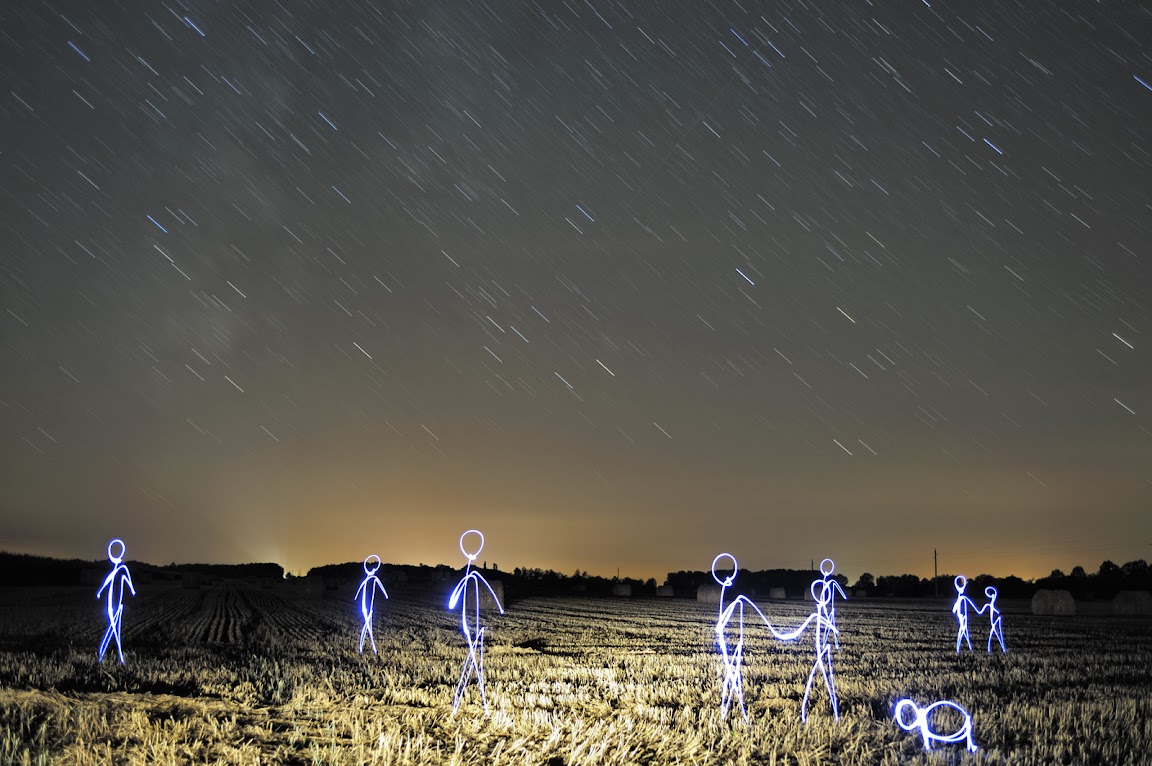
Apropos of nothing, this extremely cool image, which was not digitally manipulated to look this way (other than, perhaps, adjusting white balances and such). The stars are streaking because of the long exposure time of the camera (probably several minutes, at least). The figures were drawn by the photographer with flashlights. Click on the photo to see the rest of his photo set.

Much in the same way you can draw figures in the dark with a sparkler, by leaving an afterimage in your retina from the bright light, he went into the frame of the photograph, waving a flashlight around to make these patterns, which appear in the final exposure.

How come the light appears in the final exposure, but the blur of the photographer and, indeed, the flashlight itself, do not? Although they were all in frame for the same period of time, the intensity of the light allowed it to leave a lasting impression. An exposure is all about collecting light. A bright light that is present for part of the exposure may contribute as much to the final picture as a less-bright object that is there the entire time.