About J.J.S. Boyce

I'm a freelance writer, critical thinker, science fiction fan, addicted traveller, and educator, with continuing interests in all of the above. Comments can be left on site or via e-mail, at jjsboyce (at) hotmail (dot) com. For a more detailed bio, see About.

This and That

There are only three more full weeks before we return to Canada, and there’s lots to do. I’ve just finished the Murakami book, so I need to write up my review for that. That leaves me with four more review books to read this month.

Odds are I’ll still be working on the last one as our plane touches Canadian soil, but as I know I have fresh new review material waiting for me at home, I’m endeavouring to be as close to caught up on my Costa Rica reading as possible by the time we head back. I don’t want to arrive there with more than one unfinished book.

I’ll be doing my usual Care2 blogging throughout the week, and I’ll also be working on a piece I’m writing for a magazine, which I won’t name unless and until they actually decide they like what I came up with and are going to run it. I don’t want to count my chickens, after all.

I have been reasonably diligent with submitting other unsold articles, but don’t expect too much to happen with that, at least immediately. I’ve already mentioned a new blogging gig, but I don’t even know if it’s going to start this month, since the site itself has yet to be launched.

The last week we’re here will involve a lot of last-minute touristy stuff. A canopy tour, a trip to the zoo, a couple last treks to the ocean, and even just local stuff in our nearby towns. My writing output will probably be lower that week as a result (not to mention the need to clean house and pack). So I hope to be on the ball this week and next and keep to a good working schedule.

That’s all for now.
Care2 Blog Weekly Roundup (02/03/12)

Environment:

Time to Stop Canada’s Polar Bear Hunt

Increase Arctic Shrubbery May Destroy Permafrost

NYC Cancels Winter Jam, Citing Lack of Winter

Hanford Site: Radiation Levels High, Progress Slow

Top Industry Experts: Green Energy is a Smart Investment

Animal Welfare:

Cat Undergoes Revolutionary New Full Knee Replacement

Civil Rights:

Are We Living in a Caste Society?

African Americans for Humanism Launch Awareness Campaign

Pseudoscience, Women’s Rights, and Skepchicks

Politics:

Is Anyone Out There? Do We Care?

Who Are the Real Advocates For Oil?

New Study Links Racism and Conservative Beliefs with Low IQ

The Convenience Button and the Ethics of Climate Change

Rogers Challenges Truth in Advertising, Citing Civil Rights

What Are We Here For?

No existential angst, no ennui. What I mean to ask with that post title is what are we doing here on this site? I know why I’m here. I find it useful to keep track of what I’m working on, even if I only discuss unpublished projects obliquely. It’s also somewhat useful to provide a pointer to potential clients where they can see some of my work.

Readers, though, I’m not so sure about. Ideally, someone who likes something I’ve written can come here to find links to more of my stuff. But I’m not sure how well that would work. Recently I’ve had a spike that could only have come from readers of my articles at Care2 following the link in my bio. A smaller number likely come after reading one of my book reviews at any number of sites.

But will a person who reads a book review I wrote about a Heinlein juvenile be interested in my book review of The Manga Guide to Biochemistry, or The Authorized History of MI-5 (each published somewhere different)? And that’s just my reviews. I write about educational policy, popular science, literary criticism, straight up travel writing, food blogging. If someone who read one piece of mine were to choose something else I wrote completely at random, the odds would probably be against them actually being interested.

And it’s not even entirely about my interests, but a part of freelancing. If I can write something and get paid for it, I have to do it. I don’t much care about stock analysis but I have just enough knowledge to do so competently, and I can’t pass on a commission when it’s offered. Broadness pays off in freelancing. (Though limiting one’s writing only to those things you’re really interested in is a luxury I look forward to when I finally get back to my day job next month and return to writing part-time.)

On the other hand, maybe I’m wrong. There may be some very eclectic readers out there, after all. If so, feel free to stick around.

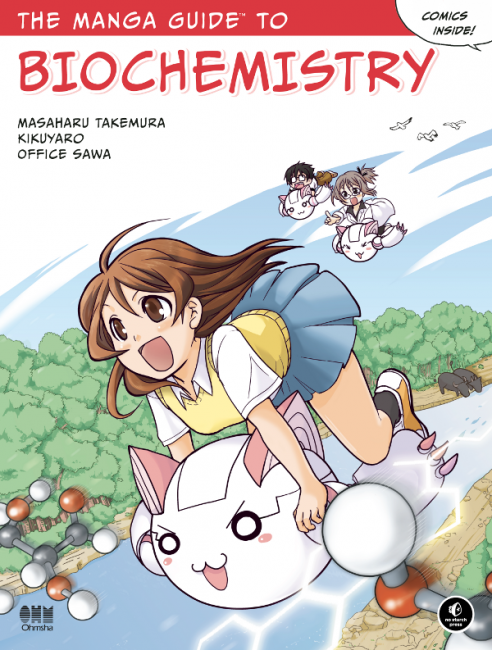
Book Review: The Manga Guide to Biochemistry

I was looking forward to No Starch Press’ latest Manga Guide release for months before it actually came out. I quite enjoyed The Manga Guide to Molecular Biology, and thought this would make for an excellent companion piece. Obviously I wasn’t the first person to think so, the author of that previous book, Masaharu Takemura, must have felt the same or he wouldn’t have agreed to write this one as well.

Biochemistry and molecular biology are like solid state physics and physical chemistry or, if you like, psychology and sociology. Both disciplines find themselves interested in many of the same phenomena, but consider slightly different aspects of each one.

Molecular biology is interested in how the body works as a system on the sub-cellular level. The basic processes of life are considered with respect to how they manage to maintain all the functions of a cell. Biochemistry is interested in all the chemical behaviour involved in life, which ultimately is responsible for all those same cellular functions.

Both books discuss many of the same ideas, therefore, but there’s virtually no overlap in content. In Molecular Biology, enzymes were considered as helpers in chemical processes. In Biochemistry, more time was spent on the specific reactions they catalyzed, and the actual chemical structures of reactants and products. Both books discuss the way DNA information is read and translated into specific proteins, but biochemistry goes into the chemical detail of DNA, RNA, and the amino acids that make up a protein and determine its folding.

The storyline is cute: Kumi is a teenage girl constantly worried about her weight. She decides to study biochemistry so she has a better understanding of her metabolism and its relationship to weight gain. This is not just an entertaining framing device; Takemura is intentionally using a non-traditional approach to the topic, introducing major chemical characters into the narrative in an organic way as they become relevant to particular chemical processes.

Proteins, fats (lipids), and carbohydrates (saccharides or sugars) are each discussed in different chapters. The chapter on carbs isn’t really just about carbs, it’s about how sugars are used to create ATP which in turn provides energy for the cell (amongst many other things). The chapter on proteins isn’t just about the Atkins diet, it’s also about how enzymes are created and how they function as biological catalysts.

This isn’t the first Manga Guide to take a non-traditional approach to a topic. Calculus took a much more intuitive, less mechanical approach to derivatives and integrals, though not a less rigourous one. Universe followed a historical sequence in discussing the heavens, steadily overturning pre-conceptions as contradictions were discovered. And all of the books in this series have emphasized real-life examples and applications, whatever the topic. The chemical reactions discussed in the book are used to explain everything from the ripening of fruit to the springiness of mochi-style rice.

And it works. There are a number of topics in science that are frequently taught a certain way because it makes it easier to organize a textbook, or faster to “cover” in class, even though it’s not the most efficient approach to actual learning. I appreciate this series’ willingness to eschew traditional learning sequences in favour of intuition, learning in context, and developing ideas organically from previous knowledge. Another enjoyable entry to the series.

(No Starch Press, 2011)

Reprinted with permission from The Sleeping Hedgehog
Copyright (2012) The Sleeping Hedgehog

Submitted for your approval . . .

I’ve been lax in submitting my freelance work lately. Since I got a regular gig at Care2, I’ve been spending my mornings writing articles that I know will run, rather than investing my time submitting previous pieces to markets who may or may not be interested. I’ve also been tapped to contribute to another soon-to-launch site, which makes it even easier to keep busy with my writing (more on that later).

But I’m going to be slowing down my output at Care2 a bit compared to last month. I’ll write when something really strikes me; maybe a few posts per week. Not because I’m not enjoying it — it definitely beats the more technical stuff I’ve done a lot of in the past: stock analysis or calculus tips, for example. But I’m ready for a little break.

What I’d really like to see in print is a little thing I wrote all about tea. That may not immediately sound fascinating to you, but I enjoyed writing it. It’s a sort of spiritual successor to one of the more popular piece I’ve written, called “The Art of Science — The Science of Art?” I might define it as creative non-fiction moreso than feature writing, if I stop to think about it; particularly the tea article, since I let myself loose stylistically a bit more.

I had this piece in mind for at least six months before I actually wrote it. Where my previous piece in this vein started out talking about DNA but used that as a jumping off point to discuss the works of Salvador Dali, this newer piece starts off with me talking about my chemistry lab and then discussing all sorts of little-known facts about my favourite hot beverage. It’s a kind of writing I really enjoy because it combines my interests in science and culture by drawing connections between them.

It’s also difficult enough to categorize that finding the right market is a challenge. But if I don’t keep sending it out, it won’t happen. And the same goes for everything else that’s making the rounds at the moment. You have to submit. It’s a basic rule of freelancing: keep your stuff circulating until it sells.

Care2 Blog Weekly Roundup (01/27/12)

Politics:

Climate Change Deniers Set School Policy, Forecast Weather

Post-Fukushima, Nuclear Policies in Flux Around the World

“Climate Skeptic” Thinktank Asked to Reveal Secret Funders

Act on ACTA: The Internet War is Not Over

Canadians Want Legislation to Regulate Sex-Specific Abortion

Animal Welfare:

Texas Pastor Kills Neighbours’ Cat

Why We Will Boycott “The Grey”

Environment:

Tipping Point: Amazon Basin Becoming a New Carbon Source?

Migratory Birds Struggle to Adapt to New Climate

First Look Inside Fukushima Reactor

Responses to Heinlein’s Starship Troopers

John Scalzi recently wrote a post for Tor.com about Starship Troopers the film, listing several reasons for watching it. The film is ostensibly based on Heinlein’s book of the same name, which, amongst other things, is often credited as creating the military science fiction genre.

My own reason for watching it, a couple years ago (or, rather, re-watching it), came from this AV Club post, which told me a lot about director Verhoeven and his intentions with the film I hadn’t picked up on the first time through. On the surface, it’s a crappy, brainless action movie. A little deeper, it turns out to be incredibly satirical, both anti-war and an intentional argument against the very ideas Heinlein put forth in the film’s source material.

Some might suggest he misrepresents Heinlein’s ideas in responding to them. For example, he’s clearly stated his belief that Heinlein’s imagined society was fascist, but this isn’t really a fair reading. Still, I’m of the school “everyone should read Heinlein, but never stop arguing with him”. So I appreciate the effort to refute him, even if Verhoeven does a sloppy job of it.

And I did get something out of re-watching the movie with a more critical eye; I even went back and watched Robocop for the same reason. But when it comes right down to it, I didn’t enjoy either one. They may only be pretending to be crappy, brainless movies — hiding deeper messages just below the surface — but really, what’s the difference between pretending to be and actually being crappy?

For that matter, the messages were pretty vague and simplistic. They’re anti-fascist, and? Can you get a little more specific with that? In the end, I suspect there’s only so much you can do with satire compared to a more detailed argument in a compelling story. That’s why Brave New World can’t live up to 1984. The former is satire at the expense of being real literature.

For that matter, I don’t need Verhoeven’s to refute Heinlein. It’s been done. The Forever War was written maybe 15 years after Starship Troopers, and is a clear, politically-opposite response, written by a veteran just returned from Vietnam, no less. Joe Haldeman had both the writing and military creds to challenge Heinlein, and in so doing may have exceeded his work.

In fact, even Verhoeven’s cheerleader, Scalzi himself, has done this. Old Man’s War is clearly aware of Heinlein’s work, challenges it, and is an excellent novel in its own right. Scalzi should just read his own book next time he feels the urge to watch Verhoeven’s film.

I guess the moral of the story (as I take it) is that even when something is arguably important as part of a body of critically relevant work, it may have few artistic merits of its own.

Book Review: The Green Hills of Earth & The Menace from Earth

The stories of Green Hills have that special just-can’t-wait-for-the-future sheen that science fictional works of the ’40s and ’50s tended to have. Luna City, colonies on Mars and Venus, a new class of adventurers and fortune-seekers rocketing to the outer planets to establish new outposts and write their own tickets. There’s opportunity for the taking, if you just have brains and gumption enough to get it!

Read my complete review on Revolution Science Fiction.

Sweating to Books on Tape*

A few years ago when I was living alone in China, my job gave me a significant amount of free time. I taught either one or two classes per day (biology and pre-calculus), had no official office hours — I was able to make it to the gym most weekdays (morning or afternoon depending on my schedule) and had all my evenings free save Tuesday nights when I ran a sort of phys ed program until about 5:30 or 6:00.

What I didn’t have were friends. That may be part of the reason I started listening to audio podcasts. Craving the human voice (in English, rather). I listened to Escape Pod and enjoyed it quite a lot, though I stopped being able to keep up after a few months back in Canada, particularly once I was working a genuine full-time teaching job.

I do like audio fiction, and it’s particularly ideal for short stories, which I am also fond of. Not everybody is, even avid readers. Or at least, it doesn’t occur to a large segment of the reading population to pick up an anthology or collection. This is a shame, really.

Certainly there’s a place for novels and short works, both, but there are a number of advantages to short fiction, including the ability to read it in one sitting, the chance to get a number of neat and unique ideas in a single book instead of focusing on just one, the ability to see a basic narrative idea stripped bare and not buried in an overwritten novel (it’s harder to overwrite a short story and still get it published).

All of which is to tell you I was thinking of a short story I “read” some time ago (I realize I heard the audio version only), and tracked it down, and if you’re interested, perhaps you’ll give it a listen. It’s called “Usurpers”, it’s hosted on Escape Pod, and it’s about a stubborn runner in the future who refuses any sorts of bodily enhancements, but still dares to compete against modified humans. He’s kind of a jerk but the story makes an important (and legitimate) point about “grit”. It’s more important than you think. For anyone who strives for greatness, physically, intellectually, artistically. . . .

*The title is a reference to a Family Guy cut-away gag.